The INDEX Coffer: Deposit veLUTE Once, Earn Twice
A vault that votes your veLUTE as a bloc, pays you in INDEX every week, and compounds LUTE straight back onto your lock. Here is the loop, stage by stage.
Most vote-escrow systems ask the same thing of you every week: vote, claim, repeat, for as long as you hold the position. Miss a week and you earn nothing that week. The mechanism is sound and the chore is real.
The INDEX Coffer removes the chore without removing the income. You deposit a veLUTE lock once. It votes as part of a bloc from then on, you are paid in INDEX every week, and the LUTE the vault earns is locked straight back onto your own position.
The interesting part is not that it automates a vote. It is that the two income legs feed each other.
The loop
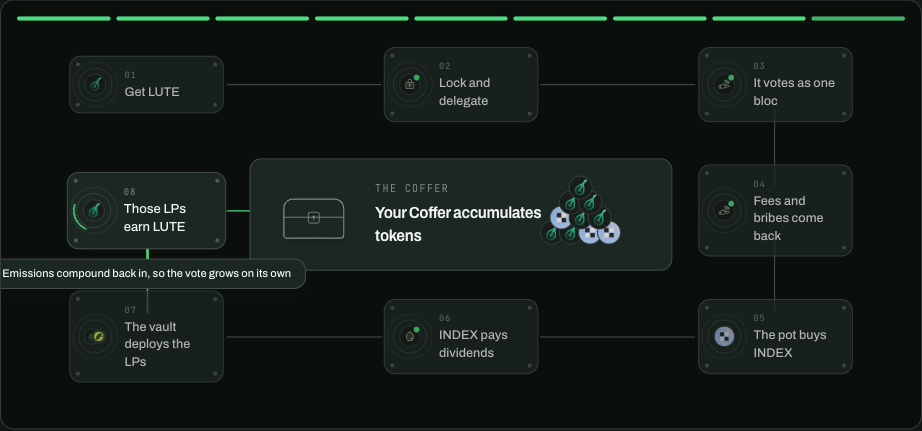
Read it as a circle, because that is what it is:
- You lock LUTE and get veLUTE, a vote-escrowed NFT.
- You delegate it to the Coffer, which folds it into one managed position.
- It votes as one bloc. Not your lock alone, but every depositor's together.
- Fees and bribes come back from the pools that bloc voted for.
- The pot buys INDEX with that revenue.
- INDEX pays dividends. This is the stage that makes the rest work.
- The vault deploys those dividends as protocol-owned liquidity.
- That liquidity earns LUTE emissions, which are locked back onto your position, so the vote behind it is larger next week than it was this week.
Stage 6 is doing the load-bearing work, and it is worth being precise about it.
Why the payout is INDEX and not a stablecoin
A vault that paid you USDG would stop at stage 5. Revenue in, stablecoin out, end of story. That is a perfectly good product and it is not this one.
INDEX is not an inert payout. It is a coin with a treasury, and that treasury holds tokenized equities — NVDA, MSFT, AAPL, AMZN and a dozen more, verifiable on chain. It drips that stock to its holders. The Coffer's reserve is a holder, so those drips land in the reserve.
That is the difference between a payout and a flywheel:
| A stablecoin vault | The INDEX Coffer | |
|---|---|---|
| Week 1 revenue | Paid out, gone | Paid out and still working |
| What the unclaimed balance does | Sits there | Earns tokenized-stock dividends |
| What those dividends do | — | Become protocol liquidity |
| What that liquidity does | — | Earns LUTE emissions |
| Where the LUTE goes | — | Into your lock, growing your vote |
Each lap makes the next lap bigger. Not because of a token emission schedule, but because the vote weight behind the whole thing grows every epoch.
The trade-off, stated plainly
Here is the one rule that costs real money to misunderstand.
Each week's LUTE is split over the INDEX that was left unclaimed.
The INDEX sitting in the reserve is what earns the dividends that become the liquidity that earns the LUTE. So a depositor who claims their INDEX in full every week earns no LUTE at all. They take one leg instead of two.
Drawn as a fork, because that is the shape of the decision:
This is not a penalty and it is not a lockup. Your INDEX is yours from the moment it is credited, and claiming it does not take your lock out of the vault or touch your veLUTE. It only ends that INDEX's contribution to the compounding leg. The honest advice is to claim when you actually want the INDEX, rather than on a schedule.
What bloc voting is actually worth
The part people underrate: fees and bribes are paid on vote weight, and the richest bribes go to whoever can visibly move a pool.
A small lock voting alone is not moving anything. It collects its proportional share of whatever the pool happened to earn, and no protocol is bidding for its vote specifically. Inside a bloc, the same lock earns at the bloc's rate, because the bloc is large enough to be worth bidding for.
There is a second, quieter benefit. A lock deposited in the Coffer counts at permanent weight for as long as it is in, whatever term it has left. Outside the vault, voting power decays continuously toward the unlock date and you have to keep extending to hold it. Inside, it does not decay while it earns.
What it costs you
Two things, and they should be obvious before you deposit.
You stop voting. The vault votes with your weight. If you have strong views about which pools deserve emissions, keep your lock and vote it yourself — that option has not gone anywhere.
Your lock is parked. While it is in, you cannot extend it, toggle permanent or withdraw the LUTE. You can take it back out whenever the weekly window is open, and it comes back as a fresh 26-week lock holding your original LUTE plus everything that was compounded onto it.
The weekly rhythm
Epochs flip every Thursday at 00:00 UTC.
| Window | What is open |
|---|---|
| Thursday 00:00 → Monday 00:00 UTC | The week's INDEX sits in the reserve, dripping for everyone attached. Claims and withdrawals closed. |
| Monday 00:00 → Thursday 00:00 UTC | Claims and withdrawals open. |
The four-day window is not friction for its own sake. It is what keeps the accounting exact: nobody can take a payout and leave before the vote it was counted in has settled, so nobody is ever paid out of somebody else's share.
Risks worth naming
No yield is free, and a post that pretends otherwise is not worth reading.
- The rate is not fixed. It depends on what the bloc's vote earns that week and on the LUTE and INDEX prices. A week with no vote revenue pays nothing.
- Weekly operation. The cycle is run each week by an operator. The vault page shows how many epochs are outstanding, so a missed week is visible rather than silent.
- Your payout is denominated in INDEX, not a stablecoin. That is the point of the design, and it is also a price exposure you are taking on.
- Your lock is illiquid while deposited, and a permanent lock comes back non-permanent. You re-enable it yourself.
Who it is for
If you already vote every epoch, chase the best bribes and enjoy it, the Coffer is not for you and it does not pretend to be. You will beat it in a good week.
If you hold veLUTE and you have missed a vote — or you have a lock small enough that voting it alone was never going to move a pool — the Coffer is doing something you cannot do alone: pooling your weight with everyone else's, and turning the payout into an asset that keeps working while you decide what to do with it.
Where Alandale fits
Alandale is the only ve(3,3) venue on Robinhood Chain, so it is the only place where a vote-escrow position earns fees from tokenized-equity pools at all. The Coffer is what happens when you point that revenue at an asset that pays its own dividends instead of at a stablecoin: the vault is not a wrapper around someone else's yield, it is the protocol's own fee stream routed through INDEX and back into the locks that earned it.
That is also why the second leg exists here and not elsewhere. It needs a payout token with a treasury behind it, a chain where that treasury holds tokenized stock, and a venue whose emissions are worth compounding into. All three happen to be in the same place.
The mechanics in full are in the Coffer documentation, the vote-escrow background is in ve(3,3) Explained for RWA Liquidity, and the case for the fee split underneath all of it is in Why 100% of Fees to Lockers Matters.